

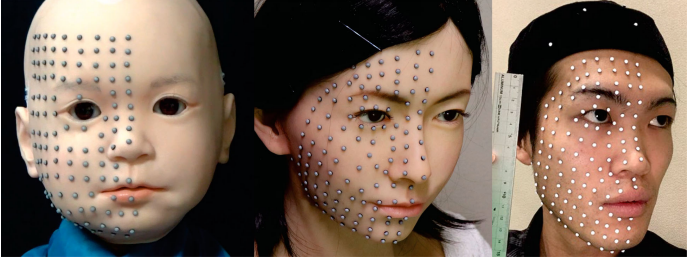
The importance of enhancing facial expressiveness in android robotics stems from the distinctive deformable facial surfaces that differentiate android robots from other humanoid counterparts. Research efforts have focused on creating more expressive android faces through innovative facial mechanisms, driven by the potential to enhance social effects through improved facial motion performance. Deformable facial displays serve as potent mediums for conveying emotional and social cues. Androids exhibit heightened emotional states by employing broader facial movements, allowing them to effectively convey emotions and social signals through distinct facial motions. Despite this potential, there needs to be more research on identifying mechanically superior android faces and evaluating their expressiveness through standardized criteria.
Traditional research highlights the number and placement of actuators within Android faces. However, this approach overlooks the influence of soft skin properties like thickness, material, and elasticity, which significantly affect the translation of patterns into actual facial deformations. To enhance facial expressiveness in androids, a numerical expressiveness index is crucial. This index allows for impartial assessments of expressiveness in each facial region, enabling comparisons between newly developed androids and human faces. Moreover, it paves the way for identifying improvements in android facial deformation mechanisms.
Defining expressiveness for each facial region is complex. In this study, facial expressiveness is defined based on the intensity and diversity of the repertoire of facial motions. A computational approach is proposed to calculate a numerical index value for facial deformation expressiveness, applicable to both androids and humans. Three visualization techniques, expressiveness maps, plots, and representative expressiveness octahedra, are introduced to explore expressiveness nuances. This index’s effectiveness is confirmed by assessing five faces, comprising android and human countenances. The assessment involves comparing mechanical performance and efficiency, pinpointing expressive and inexpressive facial regions, and suggesting strategies for enhancing android facial expressions.
Requirements and concept for Defining the expressiveness index:
(1) The expressiveness index must remain unaffected by static facial surface attributes such as size, shape, and skin color. This ensures an accurate evaluation of facial movement performance.
(2) The index’s applicability should extend uniformly across diverse facial mechanisms. It is crucial for comparing expressiveness among androids with varied facial components, encompassing actuators, transmissions, and skin materials.
(3) The index’s applicability should encompass both androids and humans, facilitating the assessment of Android technologies on an absolute scale.
(4) The index should not hinge on human likeness, a vital characteristic for accepting androids with non-human-like yet expressive facial motions.
(5) The index must be versatile enough to apply to all facial regions. This versatility is instrumental in identifying regions of expressive and inexpressive facial movements.
(6) The index should serve as a tool for examining expressiveness from multifaceted viewpoints. This versatility aids in determining the avenues for enhancing Android expressiveness.
Based on the outlined prerequisites, we introduce the expressiveness index. This index evaluates expressiveness across all facial points by gauging the maximum length, area, and volume of the approximate octahedron encompassing movable regions of facial points. The proposed index aligns with the initial four requirements, focusing on capturing variations in facial skin movements on both androids and humans. The fifth requirement is met by analyzing skin point movements on android and human faces. Moreover, to fulfill the sixth condition, we assess movement variations of a skin point within three-dimensional orthogonal evaluation axes corresponding to the approximate octahedron’s orthogonal diagonals.
Octahedral Framework of Expressiveness:
The octahedral framework of expressiveness presented in this research article offers a unique way to assess both the objective mechanical expressiveness found in Android technology and the subjective expressiveness embodied by human facial characteristics. By incorporating eight dimensions – joy, sadness, anger, fear, surprise, disgust, contempt, and neutral – this framework provides a comprehensive approach to understanding and evaluating expressive behaviors across different platforms. What sets this framework apart is its ability to capture the intricate nuances of expression within each dimension. For instance, joy can be categorized into genuine joy or forced happiness, while anger manifests as frustration or intense rage. This multifaceted view allows for a more refined analysis of expressive capabilities and brings us closer to replicating human-like emotions in Android forms.
Furthermore, the octahedral shape metaphorically represents the complexity of underlying expressions. Like an octahedron with its multiple faces and points converging towards a central core, our emotional expressions consist of various components merging to form a unified whole. This holistic perspective encourages researchers to explore not only individual aspects but also their interplay and collective influence on overall expressiveness. In doing so, we gain deeper insights into how Android technology and human faces can convey emotions effectively – providing endless possibilities for enhancing communication through expressive interfaces.
Visualizing Expressiveness: Techniques and Approaches
One of the most fascinating aspects of human communication is our ability to express ourselves through facial expressions. Our faces convey many emotions and intentions, from a simple smile to a raised eyebrow. However, how do these expressive qualities translate into the realm of technology? This question has led researchers and developers to explore various techniques and approaches for visualizing expressiveness in digital interfaces. One approach that has gained prominence is using computer vision algorithms to analyze facial characteristics. By using advanced image processing techniques, these algorithms can detect and track facial movements, allowing for real-time visualization of expressions. This enhances user interactions with technology and opens new possibilities for emotion recognition and personalized experiences.
Another technique that holds promise is the use of 3D modeling and animation tools to create virtual avatars that mimic human facial expressions with remarkable accuracy. These avatars can be used in various applications, from video games to virtual reality environments, where users can interact with them just as they would with another person. The ability to visually represent expressive qualities adds realism and immersion, making these experiences more engaging and memorable. Visualizing expressiveness in digital interfaces offers exciting opportunities for enhancing user experiences and understanding human behaviors. Whether through computer vision algorithms or 3D modeling techniques, researchers are continually pushing the boundaries of what is possible regarding replicating human expressiveness in technology.
Characteristics of expressiveness determined in androids and humans:
One of the critical characteristics of expressiveness that can be compared between androids and humans is the range of facial movements. Humans have an impressive range of movements in their facial muscles, allowing them to convey a wide array of emotions with subtle changes. Conversely, Androids often have a more limited range of movements due to their mechanical design. This can make it challenging for androids to convey complex emotions or nuances in expression accurately. Another essential aspect to consider is the synchronization between different parts of the face when expressing emotions. Various muscles work together seamlessly in humans to produce a coherent and natural expression. Androids, however, may struggle with synchronizing all their mechanical components. This can result in disjointed or robotic-looking expressions that lack genuine emotionality.
In addition to these physical characteristics, an essential factor in assessing expressiveness is the ability to respond dynamically to social cues and context. Humans are adept at reading nonverbal cues from others and adjusting their expressions accordingly. Androids may be programmed with predefined expressions for certain situations but might struggle with adapting their responses in real time based on social dynamics. This limited adaptability can affect how authentic an android’s expressiveness appears to human observers. While modern technology has significantly improved in creating expressive android faces, there are still noteworthy differences between android and human expressiveness.
What Are the Limitations:
However, even with all the cutting-edge technology and advanced algorithms, there are still certain limitations when assessing objective mechanical expressiveness in Android and human facial characteristics. One fundamental limitation is the reliance on external sensors or devices to capture facial expressions accurately. Despite the development of sophisticated camera systems, there can still be errors in tracking movements or interpreting expressions correctly.
Another limitation lies in the inherent subjectivity of human facial characteristics. While efforts have been made to create standardized measures for assessing expression quality, individual interpretations can vary significantly. Cultural context, personal biases, and subjective impressions can influence how we perceive and evaluate facial expressions. This highlights the importance of considering multiple perspectives and incorporating diverse opinions when analyzing objective mechanical expressiveness.
Conclusion:
In conclusion, the study assessing objective mechanical expressiveness in Android and human facial characteristics has shed light on a fascinating intersection between technology and human communication. The findings have highlighted the potential for Androids to mimic certain aspects of human expressions accurately but also underscored their limitations in fully capturing the complexity and nuance present in genuine human interactions. While Androids may be able to replicate basic facial movements, such as smiling or frowning, they cannot show subtle micro-expressions that humans naturally exhibit during conversations. These micro-expressions contribute significantly to understanding emotions and intentions, making them essential to effective communication. Therefore, it is crucial to recognize that although Androids have made significant progress in mimicking human facial characteristics, they still have a long way to go in achieving authentic mechanical expressiveness. Moving forward, this research opens up exciting possibilities for further advancements in Android technology and its applications across various fields, such as customer service, therapy settings, or entertainment. By leveraging insights from understanding Android limitations and our natural expressions’ unique qualities, developers can refine Android programming algorithms for improved emotional recognition and response. Mechanical expressiveness undoubtedly holds immense potential for enhancing artificial intelligence capabilities while deepening our understanding of what it truly means to be expressive as humans.
